The energy race behind AI and data centres
The hidden competition for renewable electricity in the digital economy.
Yezid Arevalo
3/17/20261 min read
Digital platforms may soon compete with entire industries for renewable electricity.
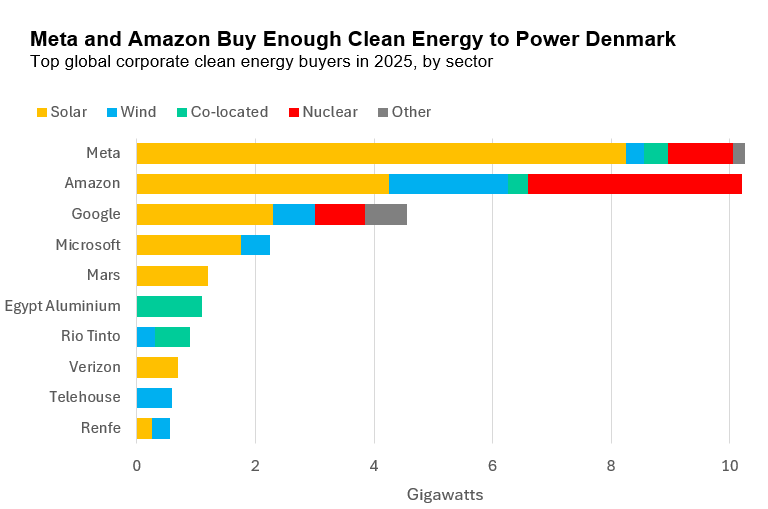
This chart from BloombergNEF shows the large share of renewable energy power-purchase agreements (PPAs) signed by major technology companies in 2025.
PPAs are long-term contracts that effectively secure future renewable generation capacity.
Only four companies (Meta, Amazon, Google and Microsoft) account for nearly 50% of the recorded global corporate purchases.
Yet estimates suggest the digital sector represents roughly 1–8% of global emissions, depending on system boundaries and accounting methods.
This creates an asymmetry:
a sector with a moderate share of emissions is securing a disproportionate share of new renewable capacity.
Most discussion focuses on supply-side solutions: efficiency, better cooling, more renewable generation.
But another leverage point may be information.
Users rarely see the carbon impact of digital actions. AI queries, cloud storage, streaming, or infinite scrolling have hidden footprints.
As systems thinker Donella Meadows noted, changing information flows can shift behaviour across systems.
Two open questions:
• Should digital platforms secure such a large share of renewable electricity contracts?
• Should platforms transparently disclose the carbon footprint of digital actions to users?
References
BloombergNEF (2026) Corporate clean energy buying fell in 2025 after nearly a decade of growth. London: BloombergNEF. https://about.bnef.com/insights/clean-energy/corporate-clean-energy-buying-fell-in-2025-after-nearly-a-decade-of-growth/
Meadows, D. (1999) Leverage points: Places to intervene in a system. Hartland, VT: The Sustainability Institute. https://donellameadows.org/archives/leverage-points-places-to-intervene-in-a-system/